Old Garage Remote on a Rural Chase Property? Why Fixed-Code Is a Security Weak Spot
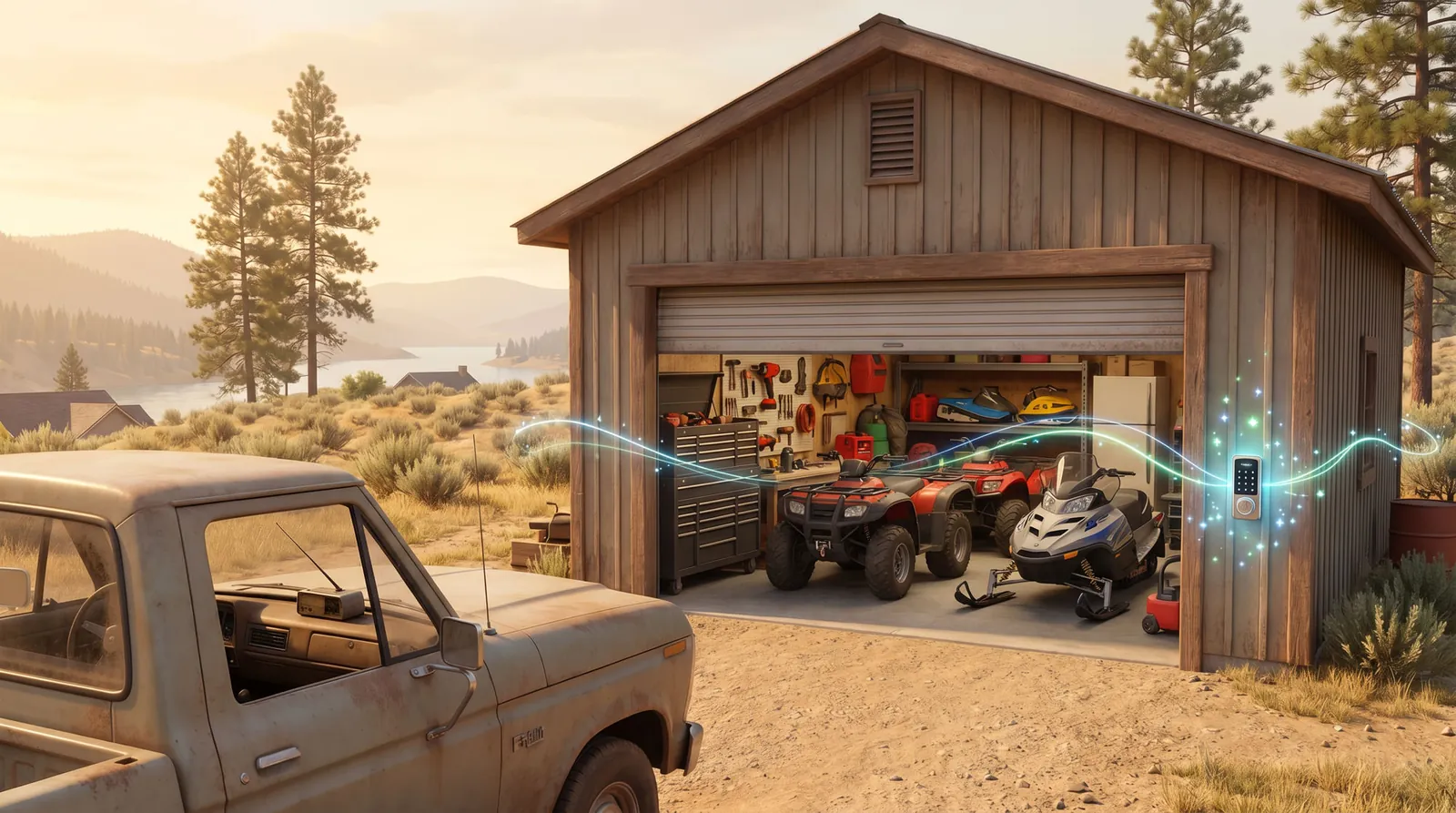
Out in the dry country around Chase and the Shuswap, a detached shop is often the most valuable building on the lot. It holds the tools, the ATV, the sled, the boat trailer, the welder, and a year’s worth of projects. And on an acreage with few neighbours and a long drive to the nearest help, the thing standing between that gear and the road is sometimes a garage remote older than the truck it lives in.
Here is the uncomfortable part. If that opener uses fixed code, the remote can be copied, and most owners never realize it.
Short answer
A fixed-code remote sends the exact same signal every time you press it, which means it can be captured and replayed by someone who wants in. Rolling code changes the signal on every press, so a copied code is useless the next time. On a rural Chase property full of valuable equipment, upgrading from fixed to rolling code, erasing old remotes, and adding a keypad closes a real security gap that an older opener leaves wide open.
Fixed code vs rolling code, kept simple
You do not need to be an electronics person to understand the difference, because it comes down to one idea.
- Fixed code sends the same signal every single time. A cheap, widely available device can sit nearby, record that signal once, and play it back later to open your door. The opener cannot tell the copy from the real remote.
- Rolling code uses a new code on every press, drawn from a sequence only your remote and opener share. Record one press and it is already expired, so a replayed signal does nothing.
That is genuinely most of it. Rolling code, sometimes branded as a hopping or encrypted code by various manufacturers, has been standard on quality openers for years. The trouble is that older long-held rural homes around Chase often still run the opener they were built with, and plenty of those predate rolling code or shipped as basic fixed-code units.
Why rural properties are the soft target
A fixed-code remote is a weakness anywhere, but the risk is sharper out in ranch country and lake-recreation areas for a few reasons.
The first is distance and time. In town, copying a remote means lingering near a busy driveway where someone notices. On an acreage off a quiet road near Chase, a vehicle can sit unremarked, and response distances mean nobody is arriving quickly. A patient person has all the time they need.
The second is the payoff. A detached shop is a tempting target precisely because it is packed with portable, sellable gear. ATVs, sleds, chainsaws, power tools, and equipment move fast and are hard to trace. One open door is a big score.
The third is habit. Rural life runs on vehicles, so remotes end up clipped to a farm truck visor, tossed in the console of a work rig, or left in a boat parked at the launch. That spreads working copies of your garage key across vehicles that are themselves easy to reach.
Closing the gap on your acreage
The good news is that fixing this is straightforward and does not require living with paranoia. It is a handful of practical steps.
Start with the opener itself. If yours is fixed code, you have two paths: upgrade the receiver or remotes to rolling code where the unit supports it, or replace an aging opener outright. Either way, our garage door opener services can identify what you have and recommend the cheaper, safer route, and we handle garage door opener work right in Chase for properties throughout the area. If your remotes themselves are the weak link or have gone missing, remote replacement in Chase gets you back to a known, controlled set.
Then add layers and tighten habits:
- Switch to rolling code by upgrading the opener or its receiver so a captured signal cannot be replayed.
- Add a wireless keypad near the door so you and trusted helpers use a code instead of loose remotes, and change that code whenever someone no longer needs access.
- Erase old remotes by clearing the opener’s memory, then reprogramming only the remotes you physically control today.
- Stop leaving remotes in vehicles, especially in unlocked farm trucks, work rigs, and boats at the launch where a break-in hands over your shop.
- Reset access when people change, such as after seasonal or hired help moves on, or the moment you take possession of a newly bought property.
If you are replacing an opener or setting up a new shop or detached garage, our installation team can spec a rolling-code system and a keypad together so the security is built in from day one rather than bolted on later.
A Chase scenario worth picturing
Say you just closed on an older acreage between Chase and the Shuswap. The seller handed you two visor remotes, the place came with a tidy detached shop, and you have already filled it with your own tools and an ATV. Everything feels buttoned up.
But that opener is a fixed-code unit from the original build, and the previous owner had a third remote on a side-by-side that was sold separately, plus a fence contractor who borrowed a clicker one summer and never gave it back. None of those copies were erased. Any of them still opens your shop, and the fixed-code signal on the two remotes you do have can be copied by anyone willing to sit at the end of your driveway for a few minutes.
Twenty minutes of work changes all of it. Clear the opener memory so every old remote dies at once. Upgrade to rolling code so the new remotes cannot be replayed. Mount a keypad by the door for the days your hands are full coming off the lake or the trail. Now access lives entirely with you, and it stays that way no matter who held a clicker before.
Don’t wait for an empty shop to find out
Big temperature swings, wildfire smoke, and long winters already give rural openers a hard life around Chase, so many are due for attention anyway. Folding a security upgrade into that work is the easy win. If you are not sure whether your opener is fixed or rolling code, the fastest way to find out is to have someone look.
, call (778) 910-3106, or and we will check your opener, identify the code type, and lay out the simplest way to lock down the shop.
Frequently Asked Questions
How do I know if my garage opener uses fixed code or rolling code?
Check the brand and rough age of the motor unit on the ceiling, plus the model number on the label. Openers built before the mid-1990s, and many basic units after that, often use fixed code. If you are unsure, a technician can identify it in a few minutes and tell you whether the receiver can be upgraded or needs replacing.
Can someone really copy my old garage remote out in the country?
Yes, a fixed-code remote sends the same signal every press, so an inexpensive device can capture and replay it. On a quiet rural property near Chase, a thief has time to do this without being noticed. Rolling code defeats this because the code changes every time you press the button.
Do I have to replace the whole opener to get rolling code?
Not always, since some openers accept a rolling-code receiver or compatible remote upgrade while keeping the existing motor. Older units, however, may be cheaper and safer to replace outright, especially if other parts are worn. A technician can price both paths so you can choose what fits your property.
I just bought an acreage near Chase, do I need to reset the remotes?
Yes, you should erase every remote the previous owner could still be holding and reprogram only the ones you control. The old owner, their family, or past hired help may still have working remotes you never received. Clearing the opener memory and starting fresh closes that gap.
Is a wireless keypad safe to add on a rural property?
A keypad is a solid option because it gives you and trusted helpers code-based entry without handing out physical remotes. You can change the code anytime, such as after seasonal help leaves or a contractor finishes. Pair it with rolling code on the opener and you have layered, manageable access.
Why does leaving a remote in my farm truck matter so much?
A remote left in an unlocked truck or a boat at the launch is a direct key to your shop full of tools and gear. If the vehicle is broken into or borrowed, your garage opens with one press. Keeping remotes with you, or using a keypad instead, removes that easy path inside.