Nylon vs. Steel Garage Door Rollers
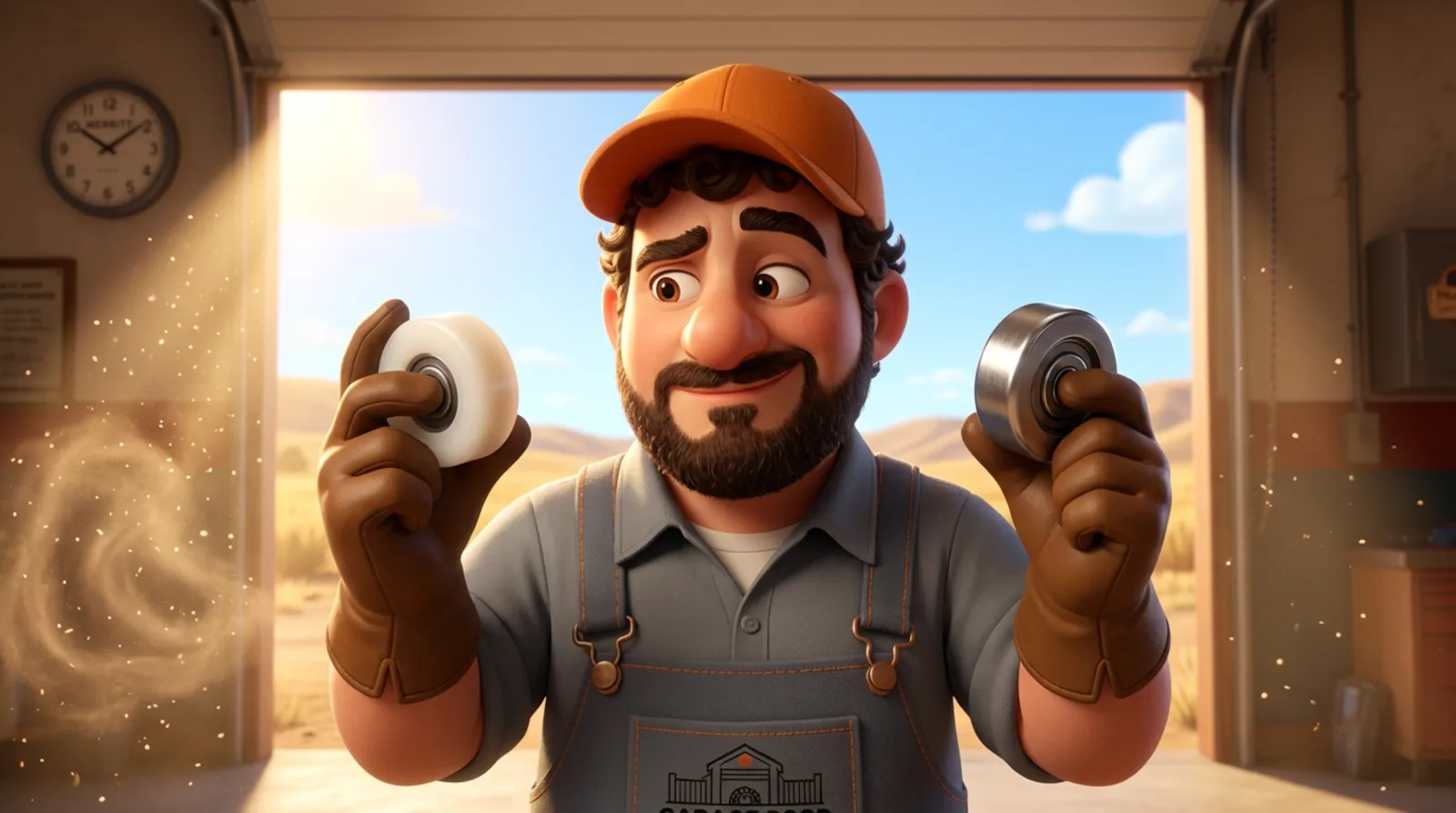
The Short Answer
Nylon rollers with sealed ball bearings are the better choice for most homes: they are much quieter, do not rust, need little maintenance, and typically last longer. Steel rollers cost less and handle heavier doors, but they are louder, their open bearings need lubrication, and they rust in damp conditions and wear faster in dusty ones. If your door is noisy, jerky, or grinding, worn rollers are a common cause, and upgrading to quality nylon is one of the most noticeable improvements you can make for the money.
How garage door rollers work
Each section of a garage door has a roller on each side, riding in the tracks. A typical residential door has 10 to 14 of them. The roller’s wheel spins on a bearing, and its stem slides into a hinge or bracket on the door. Every time the door opens or closes, every roller turns, so worn rollers show up quickly as noise, vibration, and a door that drags.
Side-by-side comparison
| Factor | Nylon (sealed bearings) | Steel (open bearings) |
|---|---|---|
| Noise | Very quiet | Noticeably louder, metallic |
| Rust | Wheel does not rust | Rusts in wet conditions |
| Maintenance | Minimal | Regular lubrication of bearings |
| Typical life | Longer | Shorter, especially with dust or moisture |
| Load capacity | Ideal for residential doors | Good for heavy and commercial doors |
| Cost | Higher per roller | Lower per roller |
| Dust tolerance | Sealed bearings keep grit out | Open bearings collect grit |
Not all nylon rollers are equal
The word “nylon” covers a wide range of quality. Inexpensive nylon or plastic rollers with no bearings wear quickly and can crack in deep cold. Quality nylon rollers use a precision ball bearing (often 11 or 13 balls rather than 7) that is sealed against dust and moisture. Those are the ones that deliver the quiet, long-lasting performance nylon is known for. When comparing rollers or quotes, ask about the bearing, not just the wheel material.
When steel rollers still make sense
- Very heavy doors, such as large wood doors or oversized shop doors, where a heavy-duty steel roller handles the load.
- Commercial and industrial doors that cycle many times a day.
- Budget repairs on a detached garage where noise does not matter.
For a typical insulated steel door on a home, nylon rollers with sealed bearings are the standard upgrade.
Signs your rollers need replacing
- A noisy, grinding, or rattling door, especially compared with how it used to sound.
- A jerky or vibrating door as it travels.
- Rollers that wobble, have flat spots, or do not spin freely when you turn them by hand.
- Cracked or chipped nylon wheels, or rusted steel ones.
- Rollers riding unevenly in the track or close to popping out.
If several rollers show wear, replace them all at once. They have done the same number of cycles, and doing the full set in one visit costs less than piecemeal repairs.
Replacing rollers: DIY or pro?
The upper and middle rollers can be swapped by a careful DIYer: with the door closed and the opener unplugged, remove one hinge at a time, swap the roller, and refit the hinge before moving to the next. The bottom rollers are different: they sit in the bottom brackets, which are attached to the lifting cables under spring tension. Removing them without releasing that tension is dangerous, so leave the bottom rollers, and any bent hinges, to a technician.
Roller replacement is often done during a tune-up, alongside lubrication, track cleaning, and a balance check.
Rollers are part of a system
New rollers make the biggest difference when the rest of the door is in good shape too. Worn hinges let rollers sit at an angle and rub, bent or dirty tracks make even new rollers grind, and a door with tired springs puts extra load on every roller. That is why a roller replacement is best done alongside a quick check of the hinges, tracks, and balance.
A few other parts are worth looking at in the same visit:
- Hinges. Cracked or worn hinges, especially the ones carrying the rollers, should be replaced with the rollers.
- Bottom brackets. Rust here affects both the bottom rollers and the lifting cables.
- Track fasteners. Loose track brackets let the track shift, which knocks rollers out of line.
- Opener force. A smoother door often needs the opener’s force setting re-adjusted afterwards.
Minor repairs and adjustments typically start around $100 to $150, and a full set of quality rollers is often fitted during a maintenance visit, so the whole system leaves running smoothly together.
Rollers in Merritt’s dry, dusty climate
Merritt and the Nicola Valley are dry and dusty for much of the year, then cold in winter, and that combination is hard on rollers. Fine dust from dry ranchland and gravel roads drifts into the garage and settles in the tracks. Open steel bearings pick up that grit, which grinds away at them until the rollers stop spinning freely and start dragging. Then winter cold stiffens whatever grease is left.
Sealed-bearing nylon rollers solve most of that: the bearing stays clean, the wheel stays quiet, and there is nothing to grease. Keeping the tracks wiped clean (without greasing them) does the rest. Our guides on clearing dust and grit from your tracks and lubricating a garage door in a dry, dusty climate cover the routine. A maintenance visit in Merritt includes a roller inspection, and if your door is already grinding, garage door repair in Merritt handles the swap.
Get a quieter door
If your door is louder than it used to be, worn rollers are a likely suspect. , call (778) 910-3106, or . A technician will check the rollers, tracks, and balance, and quote a full set of quality rollers if they need replacing.
Frequently Asked Questions
Are nylon or steel garage door rollers better?
For most homes, quality nylon rollers with sealed ball bearings are the better choice: they are much quieter, do not rust, and need less maintenance. Steel rollers cost less and suit heavy doors and commercial use, but they are louder and their open bearings need regular lubrication.
How long do garage door rollers last?
Basic steel rollers with open bearings often wear out within several years of regular use, especially in dusty or wet garages. Quality nylon rollers with sealed bearings typically last much longer. Roller life depends on door weight, how often the door is used, and how clean the tracks are kept.
Do nylon garage door rollers need lubrication?
The nylon wheel itself should not be lubricated, and sealed bearings do not need it. A light spray of garage door lubricant on the roller stem where it enters the hinge is fine. Never grease the inside of the tracks; it collects dust and grit.
How do I know if my garage door rollers need replacing?
Signs include a noisy, grinding, or jerky door, rollers that wobble or do not spin freely, cracked or chipped wheels, flat spots, and rust on steel rollers. If several rollers show these signs, replacing all of them at once is usually the best value.
Can I replace garage door rollers myself?
The upper and middle rollers can be replaced by a careful DIYer by opening the hinges one at a time. The bottom rollers sit in the bottom brackets, which are attached to the lifting cables under spring tension, so those should be left to a technician.
Do nylon rollers work in cold weather?
Yes. Quality nylon rollers are made for use in cold climates and stay quiet and smooth through Canadian winters. Cheap nylon or plastic rollers without bearings can become brittle in deep cold, which is one more reason to choose rollers with sealed ball bearings.